Tag Archives: NoAH

Manet Team joins the Jellyfish Blooms Symposium in Ireland

Every three to four years, jellyfish researchers from around the world come together for some serious fun: the International Jellyfish Blooms Symposium.

The event is one of a kind and a great opportunity to reconnect with old friends, meet new colleagues, and share the latest discoveries about our favourite marine invertebrates. This year, the 8th International Jellyfish Blooms Symposium took place in Cork, Ireland, where the Manet Team from the University Museum of Bergen presented some of our latest findings and exchanged ideas with a fantastic international community of jellyfish researchers.

Over several days of talks, posters and discussions, the symposium covered many aspects of gelatinous zooplankton research; from their fascinating life cycles and biodiversity to their roles in marine ecosystems and responses to our changing oceans. The programme also showcased how new molecular, technological and modelling approaches are changing the way we study these often elusive animals. Most importantly, the meeting provided a unique space to exchange ideas, build new collaborations and discuss where jellyfish research should go next.
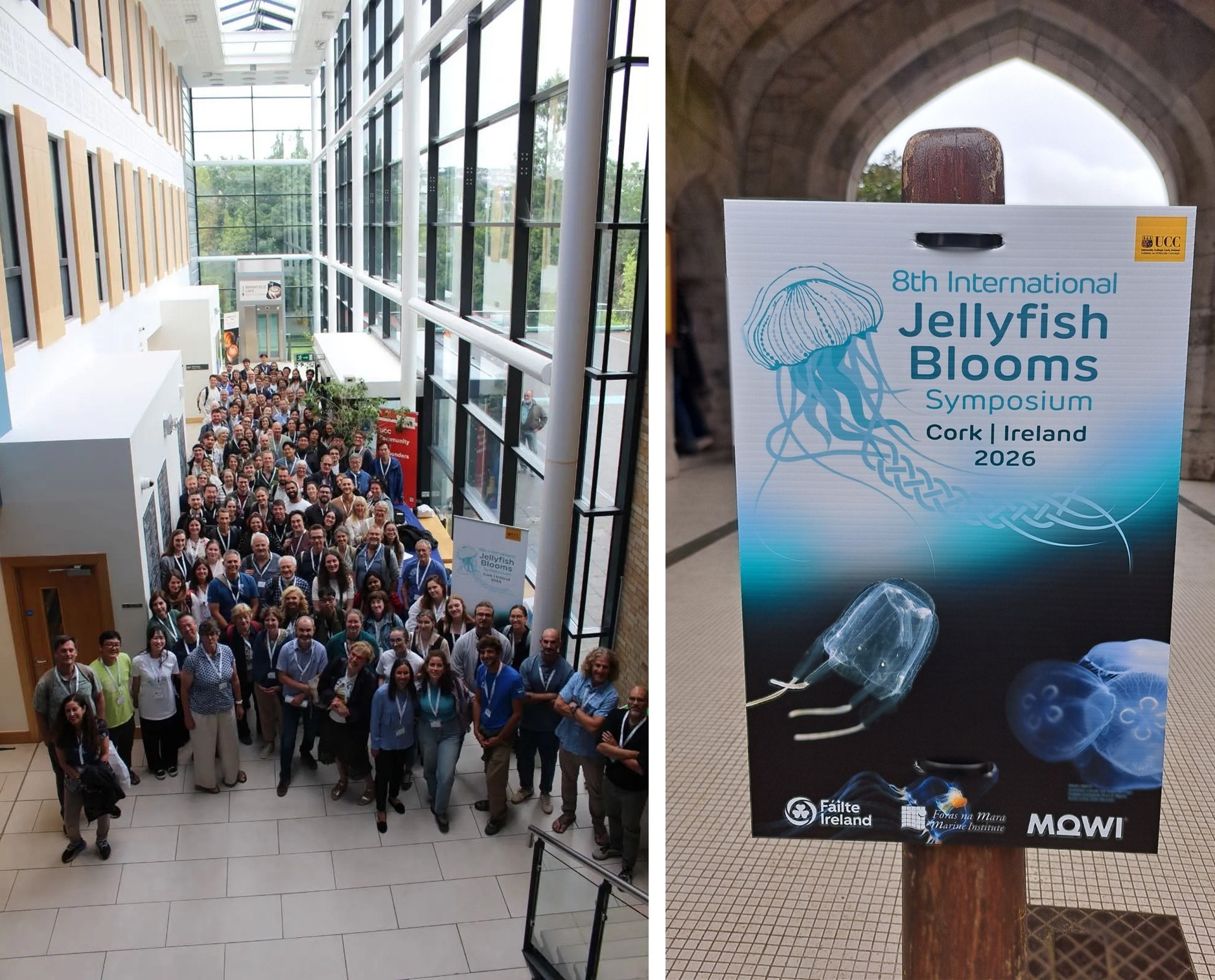
About 100 people in a group photo taken in an atrium, and a picture of the conference poster, which has different jellyfish on it
Group picture and poster of the 8th International Jellyfish Blooms Symposium. Group picture by Enzo C. Morandini

Aino opened the second day of the conference with a fantastic keynote talk on the limitations of sanger sequencing and available reference databases. Challenges we will be working on during our new Artsdatabanken project CHANGEZ. She also shared the work we’ve done over the last decade and the exciting future endeavors we are embarking on.
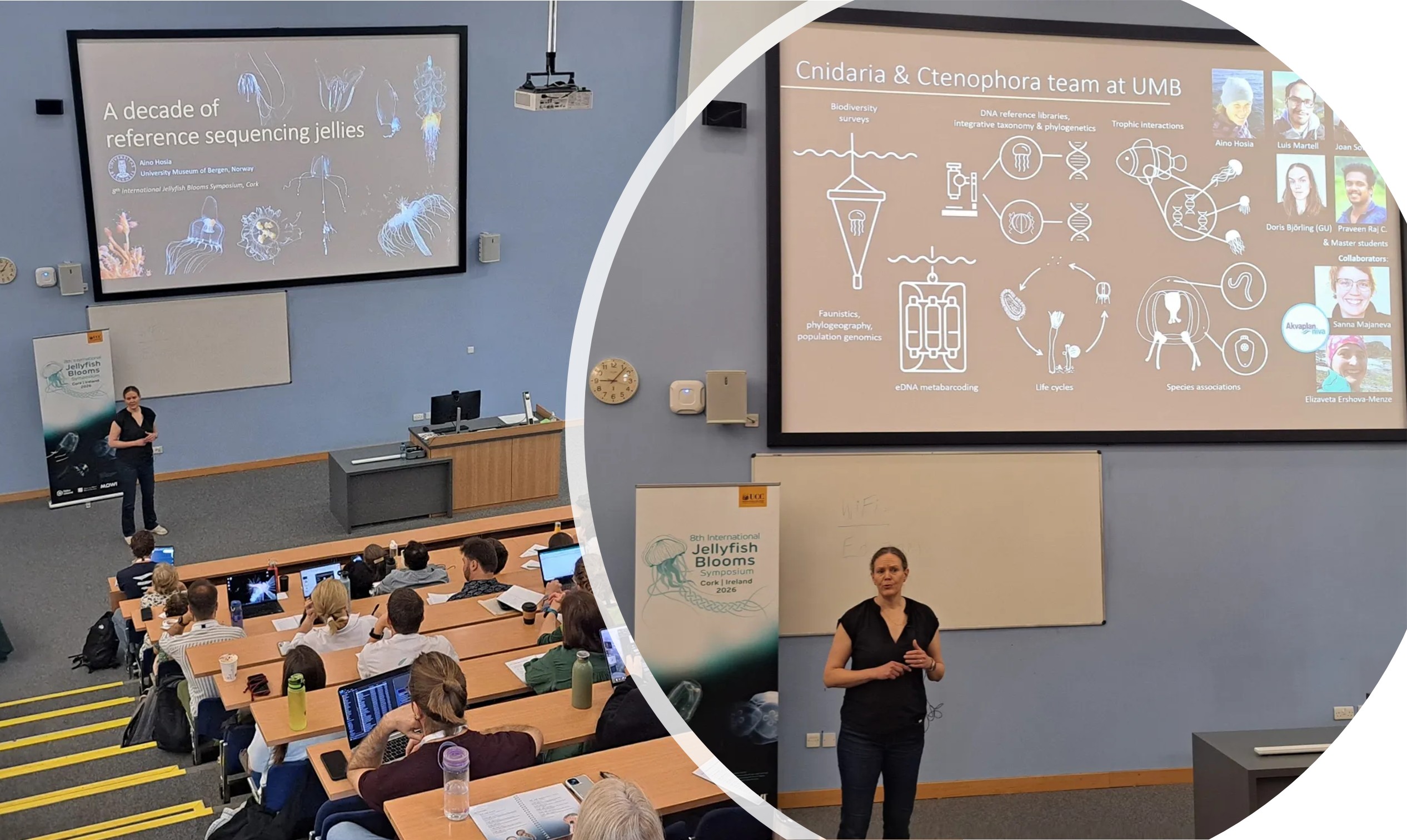
Two images of a female professor presenting a talk in the auditorium
Aino during her plenary talk: A decade of reference sequencing jellyfish.

Joan shared his latest findings on a group of substantially understudied hydromedusae and how crucial it is to integrate both life cycle stages if we aim to understand their phylogenetic relationships and distribution.
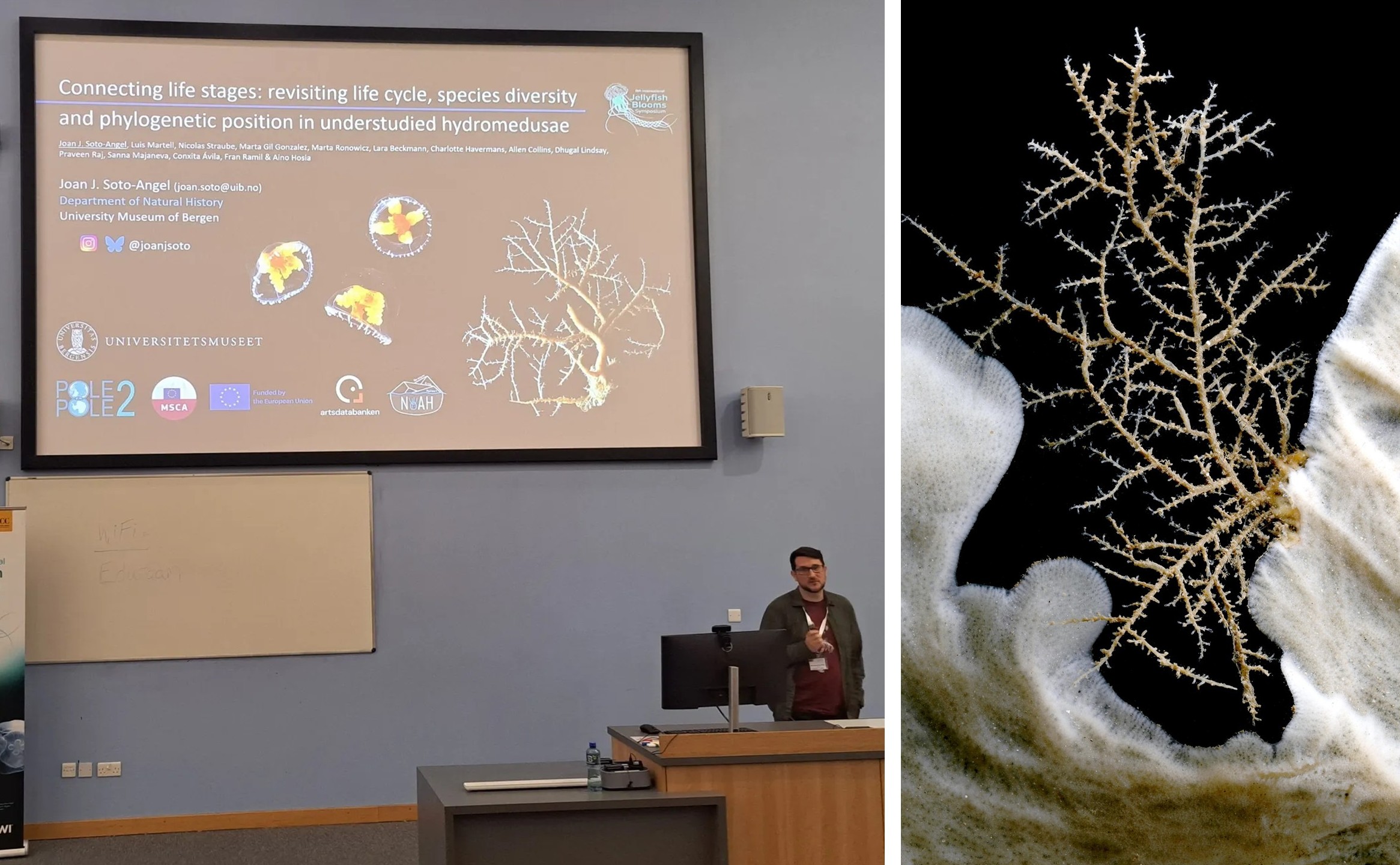
A man giving a lecture (title on slide: “Connecting life stages: revisiting life cycle, species diversity and phylogenetic position in understudied hydromedusae”. ) and a photo of a branching marine invertebrate growing on a sponge
Joan during his talk “Connecting life stages: revisiting life cycle, species diversity and phylogenetic position in understudied hydromedusae”.

Praveen focused on his results on bipolarity in calycophoran syphonophores, as part of the MSCA H2020 project POLE2POLE, funded by the European Commission.
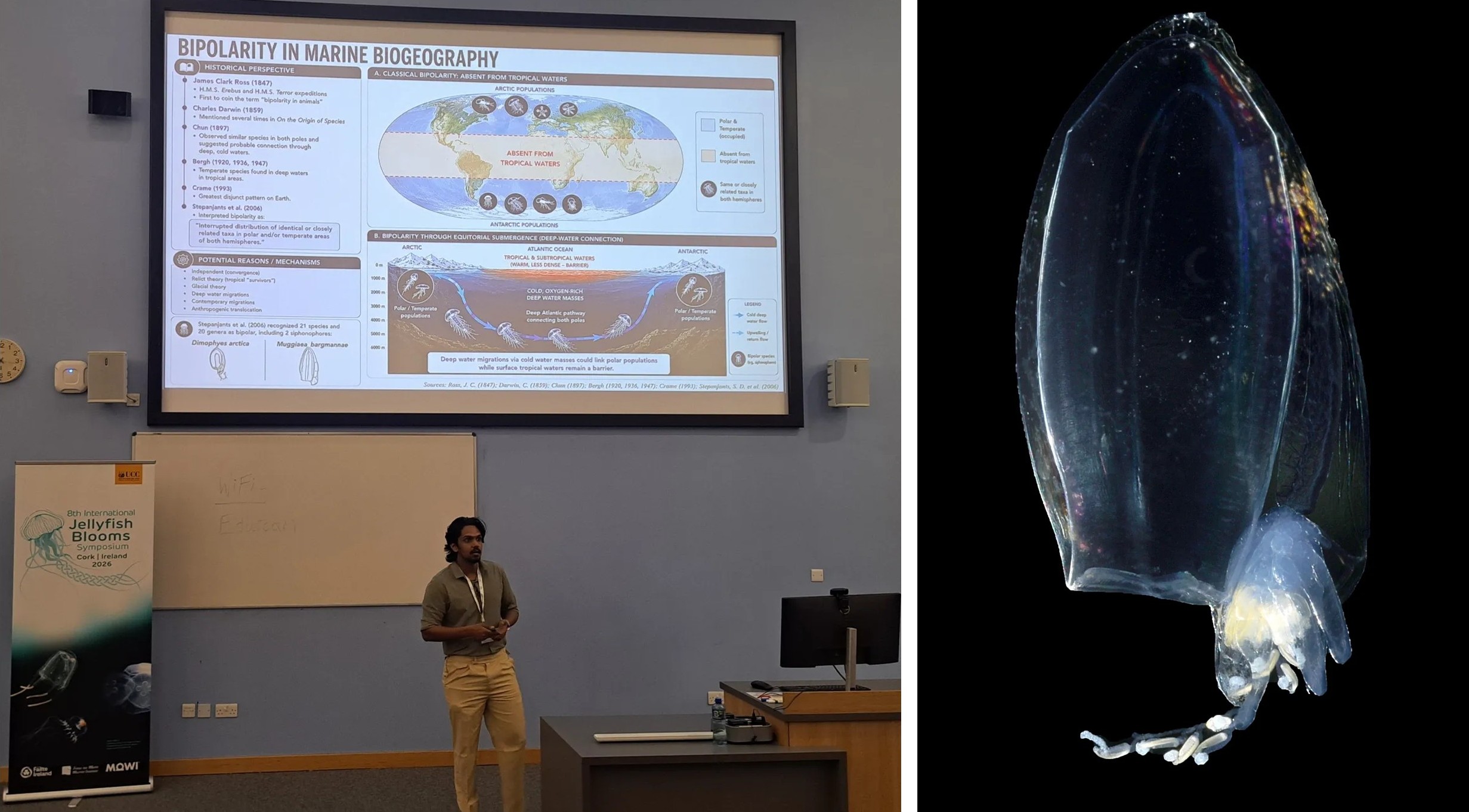
A man giving a presentation in front of an auditorium, and photo of a siphonophore, a jelly-like animal
Praveen presenting exciting results of his PhD thesis working on bipolarity in Dimophyes arctica.

Erlend explained how to properly identify pelagic hydrozoans affecting aquaculture in NE Atlantic. You can check out our ID guide here: https://zenodo.org/records/17303147 (link)
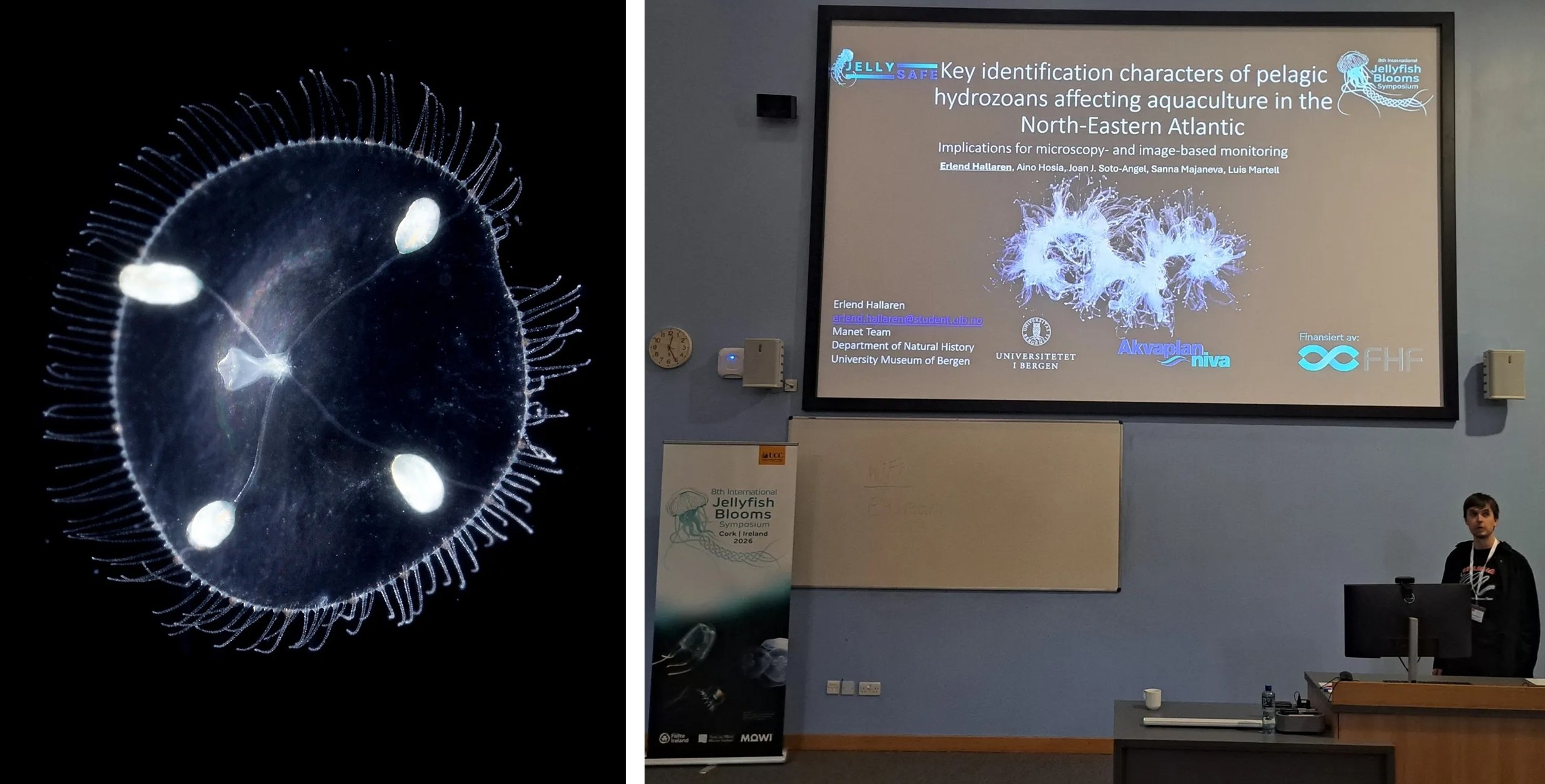
A small jellyfish with four prominent white spots against a black background, and a man giving a presentation titled “Key identification characters of pelagic hydrozoans affecting aquaculture in the North-Eastern Atlantic."
Erlend during his talk titled “Key identification characters of pelagic hydrozoans affecting aquaculture in the North-Eastern Atlantic.

Luis presented the project JellySafe, funded by FHF – Norwegian Seafood Research Fund, and the extent of the Apolemia uvaria (and other jellyfish) outbreaks for the last two decades.
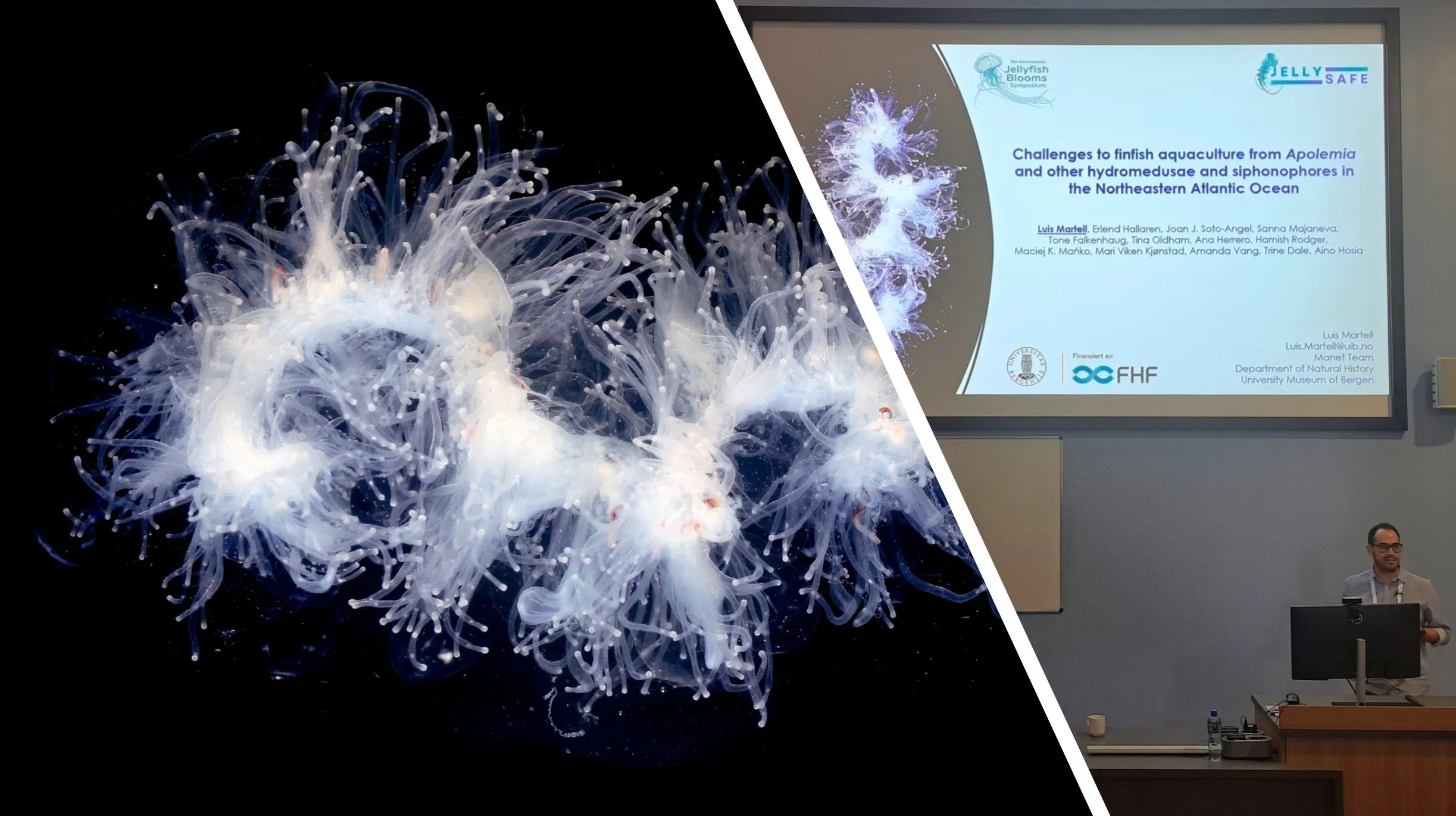
Two images, first is of what looks like a fluffy white mop, but is in fact a jellyfish - the other is of Lusi presenting his research project.
Luis presenting “Challenges to finfish aquaculture from Apolemia and other hydromedusae and siphonophores in the Northeastern Atlantic Ocean”

Doris shared how little we still know about the true diversity of tubulariid hydroids, despite being widely widespread and negatively impact aquaculture.
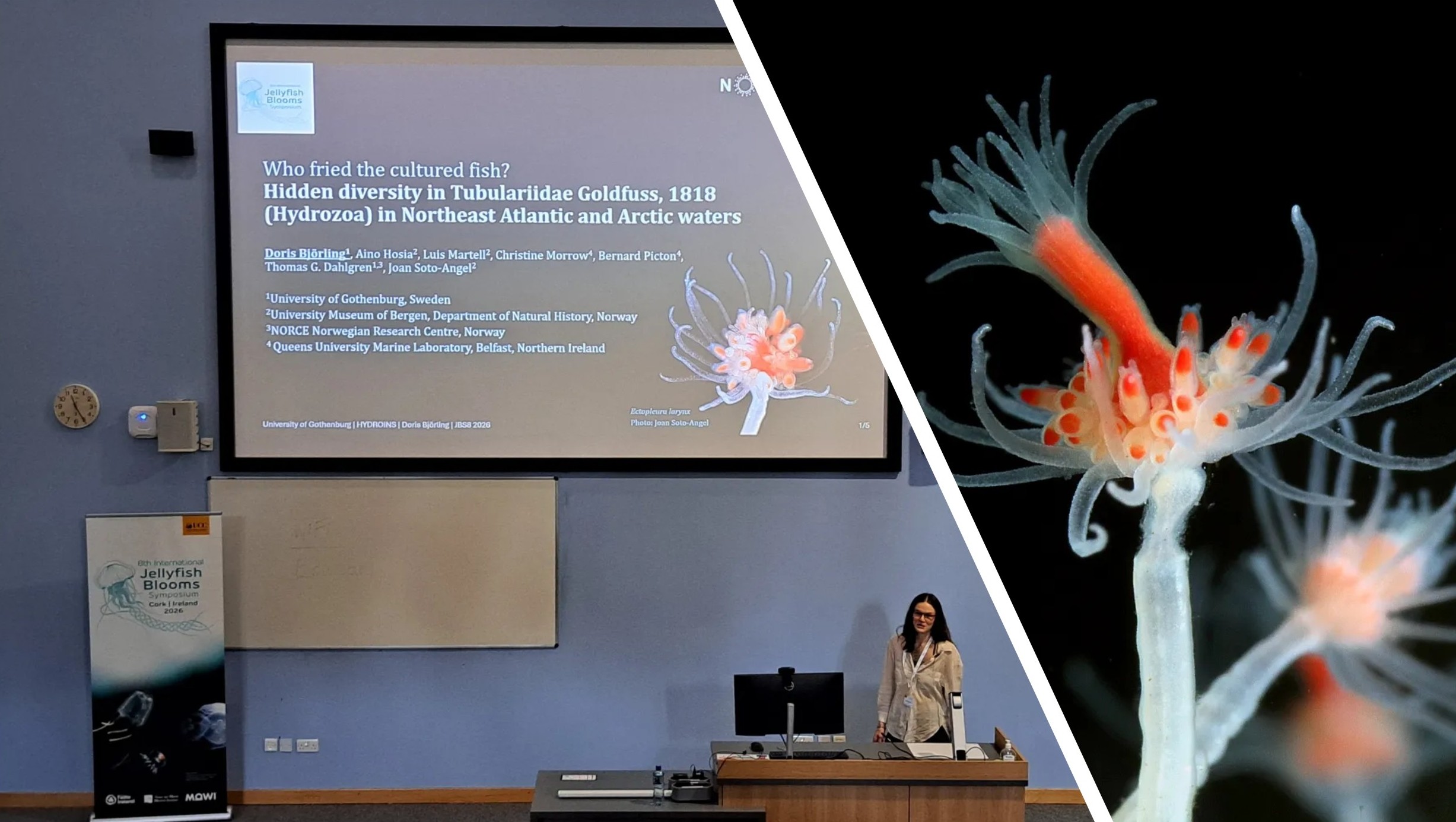
Doris during her talk on “Hidden diversity in Tubulariidae Goldfuss, 1818 (Hydrozoa) in the Northeast Atlantic and Arctic waters, and a photo of said Turbulariids, which are small, flower like animals in white and bright orange.
Doris during her talk on “Hidden diversity in Tubulariidae Goldfuss, 1818 (Hydrozoa) in the Northeast Atlantic and Arctic waters.

Besides the scientific programme of the conference, we also joined a Pint of Science outreach event promoted by the symposium’s organizing committee, where Joan gave a talk exploring the curious and often surprising lives of these fascinating animals.
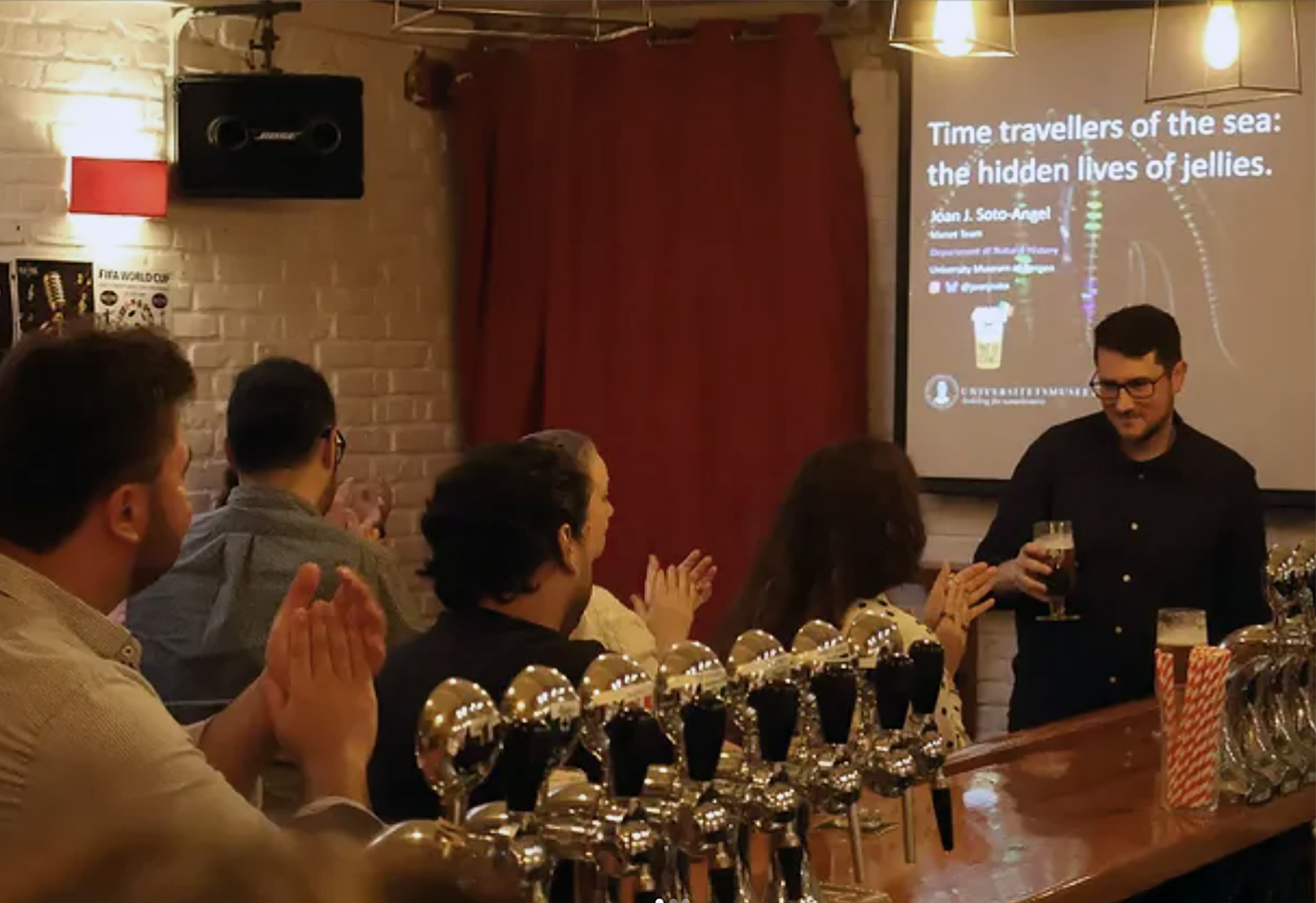
In what os very clearly a bar (lots of beer taps and bar desk), a presentation is being given about jellyfish
Joan presenting a popular talk during Pint of Science: Time travellers of the sea: the hidden lives of jellies.
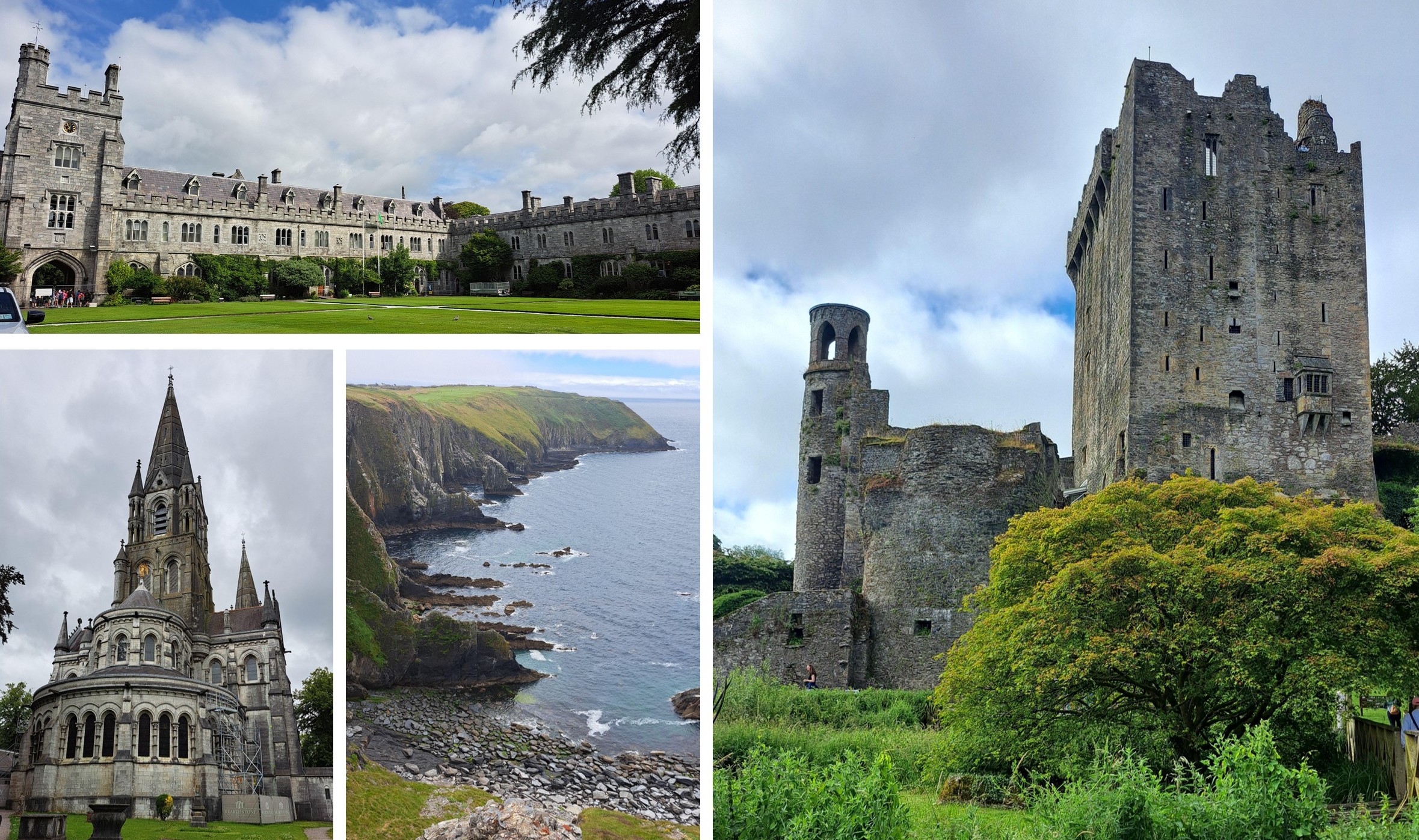
Irish sights, castles and amazing, green nature
Impressive historical buildings and breathtaking landscapes in beautiful Ireland were another highlight of our trip.

In brief: we had a great, productive and enriching experience presenting our latest findings and hearing very inspiring talks. Plus, we got to explore some of the wonders in and around Cork, with some birding whenever we had the chance. We are very much looking forward to the 9th Jellyfish Blooms Symposium in Sao Paulo 2029!
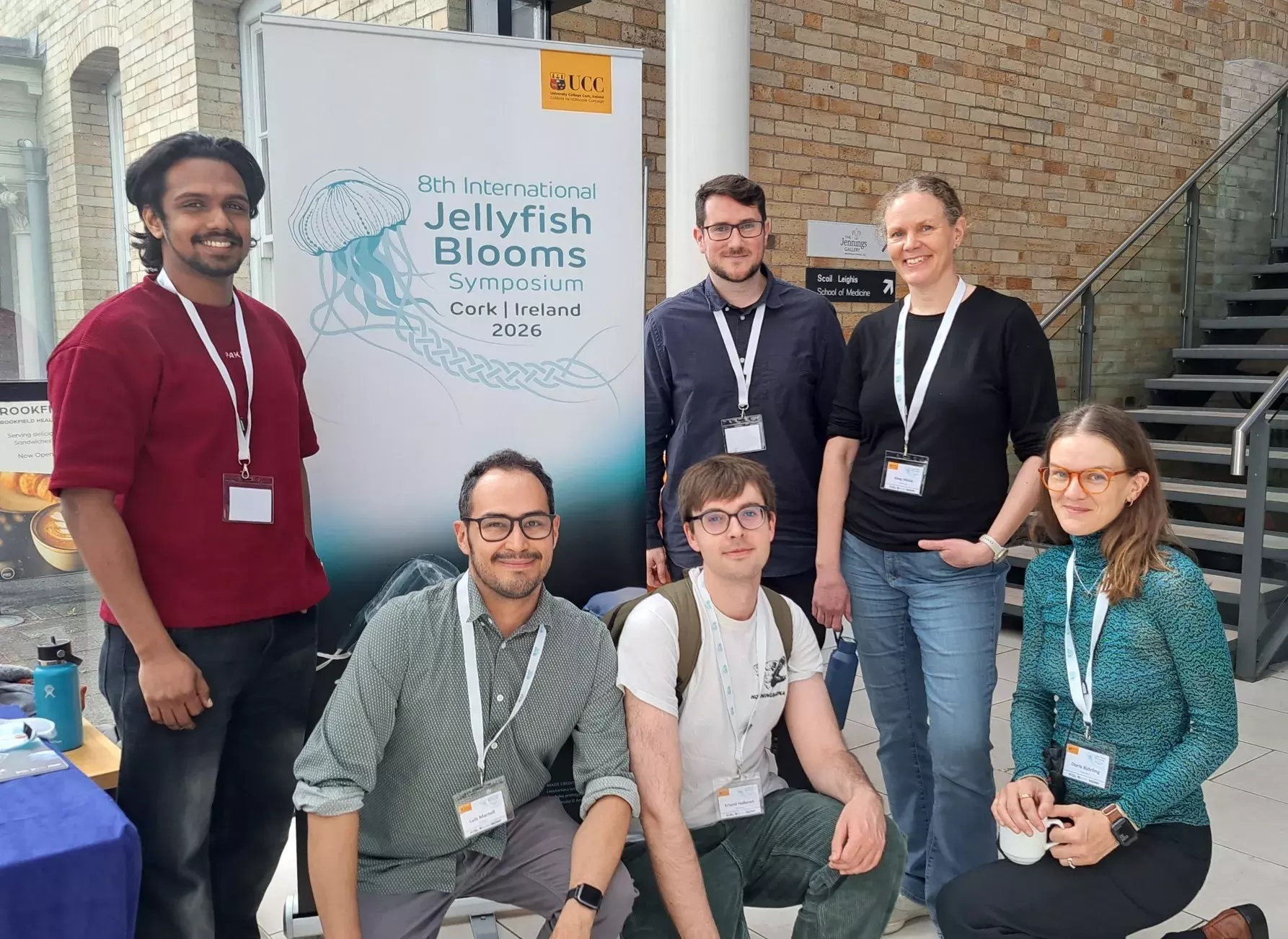
6 jellyfish researchers posing in front of a rollup with the conference logo
Happy faces in our group picture during the 8th International Jellyfish Blooms Symposium. Great job, everyone!

– Manet Team

Master theses completed!

Photo: Cessa Rauch

Big congratulations to all of out master students who have
completed their thesis so far in 2025!
Well done, Amalie, Lea, Eva, Maria, and Joe!

Lawrence, Joseph C.  (Master thesis, 2025, UiB): Bipolar or multiple species disorder? Examining the potential cryptic diversity of Ptychogastria polaris

Buhaug, Maria Grankvist (Master thesis, 2025, NTNU): Diversity and Distribution of Cyclostomatida (Bryozoa).  An Integrative Approach to Increasing Knowledge on a Neglected Taxon in Norwegian and Adjacent Waters

Samson, Eva Charlotte (Master thesis, 2025, UiB): Genetic and morphological diversity of Bylgides (Polynoidae, Annelida) in the Arctic 

DoberLea Sophie (Master thesis, 2025, UiB): Diversity and Dynamics of Parasites Associated with Arrow Worms (Chaetognatha) in Norwegian waters 

Johannessen, Amalie (Master thesis, 2025, UiB): Fauna of Ægir Hydrothermal Vent Field

We have a blog for potential master thesis topis and records of our alumni, you find it here:

Marine Masters at the University Museum of Bergen – – available thesis topics in marine biodiversity

My internship at the University Museum of Bergen (Alina)

Hi, I am Alina Lösing, a bachelor’s student from Germany with the great opportunity to join the Cnidaria and Ctenophora team from the University Museum of Bergen for a 6 weeks Internship. This experience was not only a chance to further strengthen my passion in marine biology but also very helpful to gain valuable insight into research and museum operations.

During my time at the museum, I had the chance to join various projects of Joan J. Soto-Angel, including POLE2POLE (Horizon 2020, MSCA) on bipolarity, and Artsprosjektet NoAH (Artsdatabanken) on Norwegian Arctic Hydrozoa. I even had the honor to contribute a small part to it! I focused mostly on the polyp of Stegopoma plicatile, a supposedly widely distributed species present also in both Arctic and the Antarctic waters.

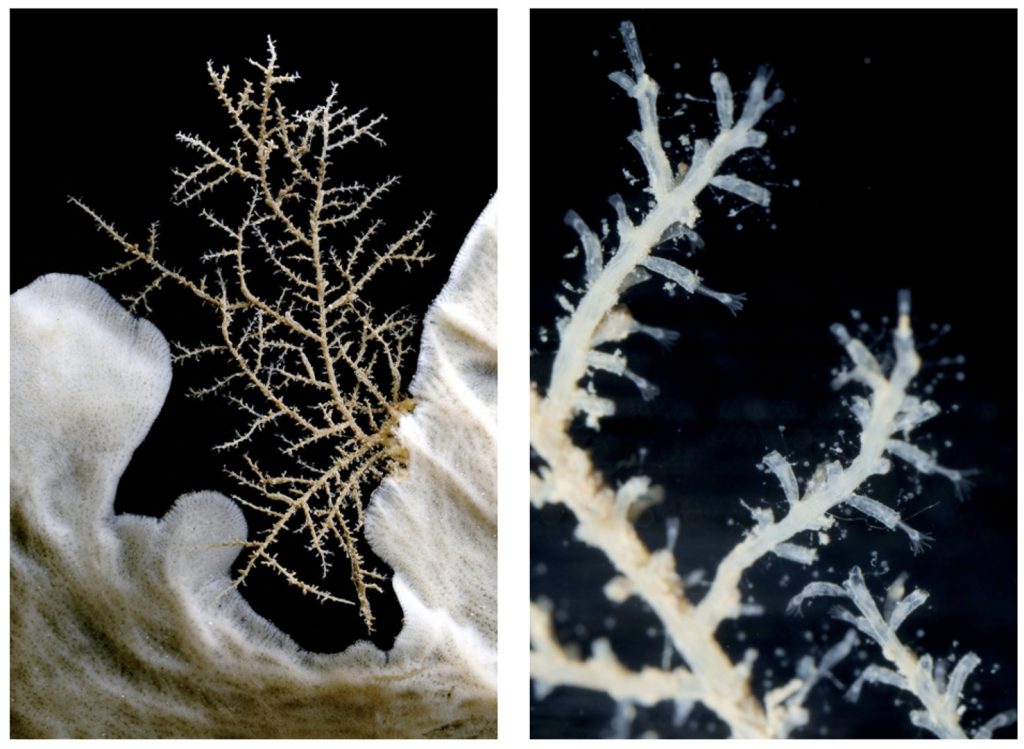
On black background branching animals looking a bit like corals

Figure 1: Living specimen of Stegopoma plicatile collected during the OceanX cruise at 240 m depth (Pictures: Joan J. Soto-Angel)

The first step was to take pictures of the different specimens that were sampled and categorized as Stegopoma plicatile. Further I took pictures of many other species of Arctic hydrozoan polyps and hydromedusae. I learned some useful tricks with the camera while photographing the different species of polyps and medusae.

Part of the project is developing a reliable workflow which allows for a morphological distinction between polyps belonging to potentially different species previously defined molecularly from different areas worldwide. Therefore, I spent a lot of time working with the microscope collecting data which can be crucial to refining the morphological differences between different species. I measured length and width of 380 nematocysts!

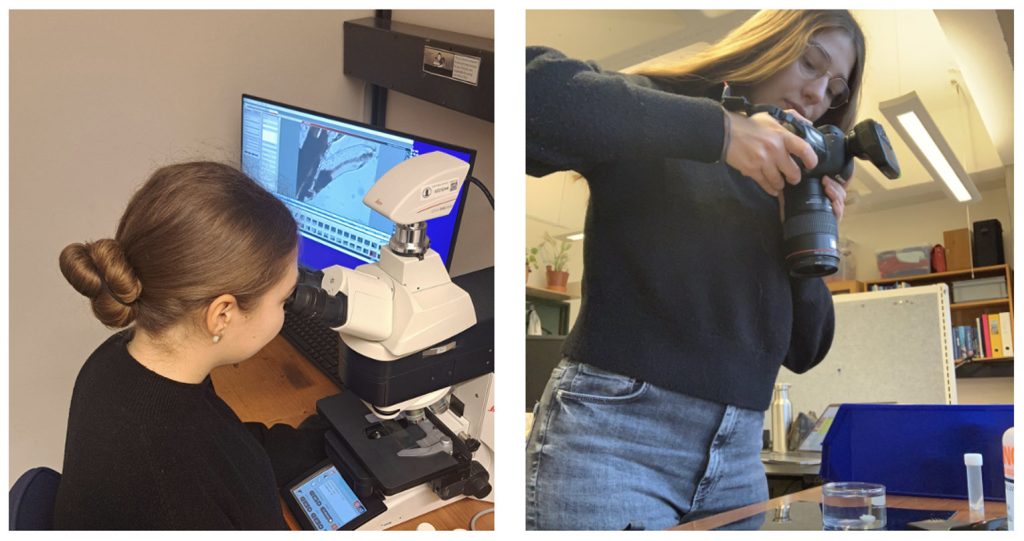
The author working in the lab; seen using a microscope with camera on top, and holding a DSLR camera

Figure 2: Taking pictures of the samples with the microscope and the camera (Pictures: Joan J. Soto-Angel)

Furthermore, I underwent training in tissue sampling, a crucial step in preparing the samples for DNA sequencing. It’s all about preventing tissue contamination! Moreover, I had the opportunity to visit the DNA Lab, where I received instruction in their specialized techniques for DNA extraction, PCR, and electrophoresis. Many thanks Cessa for your time and dedication!

The highlights of my internship were of course both sampling trips I got to attend on board the Research Vessel Hans Brattstrøm. On the ship I learned a lot about the specific sampling methods for these incredibly delicate invertebrates. Despite experiencing a bit of seasickness the first time, I assisted with net deployment, sorting the animals, and collecting water samples from different depths.

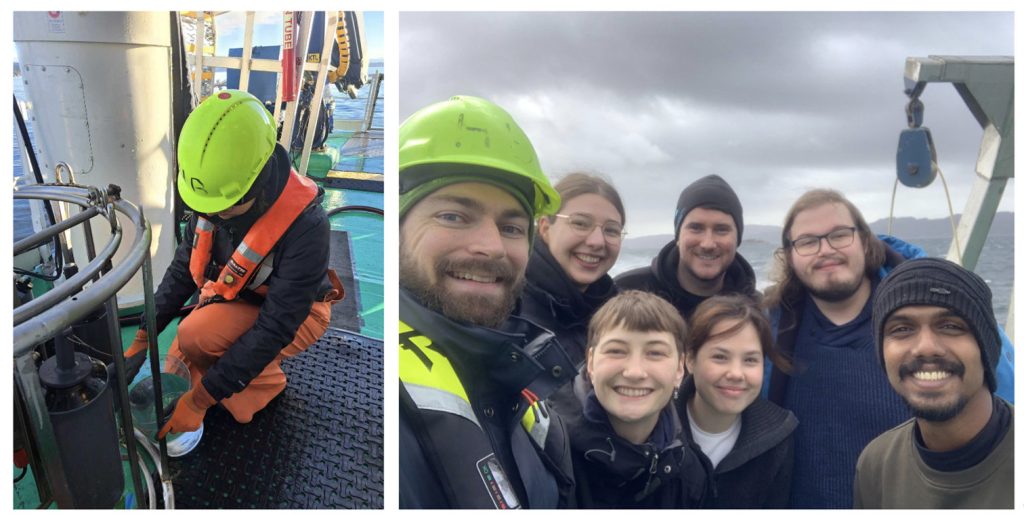
Wrok on board the reserach wesse (person holding a transparent cylinder with water) and a group photo of the participants

Figure 3: Collecting water samples from a CTD; The Team during a successful sampling day (Pictures: Luis Martell, Praveen Raj)

Apart from an amazing Jellyfish Team, Bergen has many more attractions to offer. I highly recommend packing your hiking boots for your next visit, as the surrounding mountains offer breathtaking scenery. And if you share my passion for the ocean, a visit to the Nordnes Sjøbad is a must. Here you can take a refreshing dip in the frosty ocean before warming up in the heated saltwater pool.

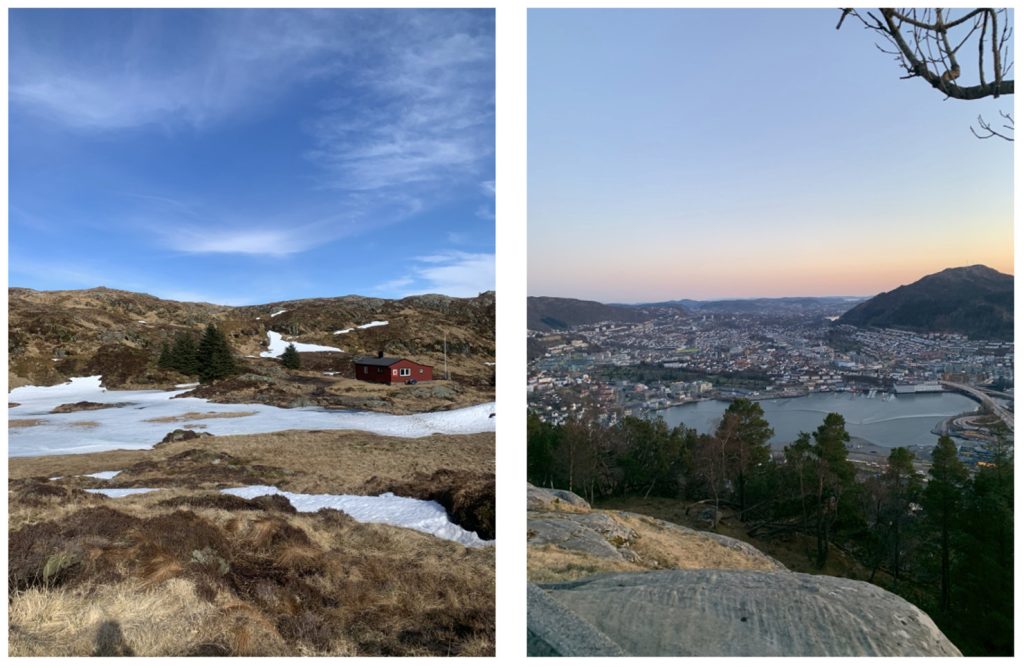
Scenic shots of nature in Bergen

Figure 4: Hike to Ulriken and Fløyen with a view of Bergen (Pictures: Alina Lösing)

 I would like to take a moment to acknowledge Joan’s invaluable contribution to my internship at the University Museum of Bergen. Joan’s dedication and extensive knowledge have made my experience truly unforgettable.

-Alina